
A Conversation with Eugenia Parry
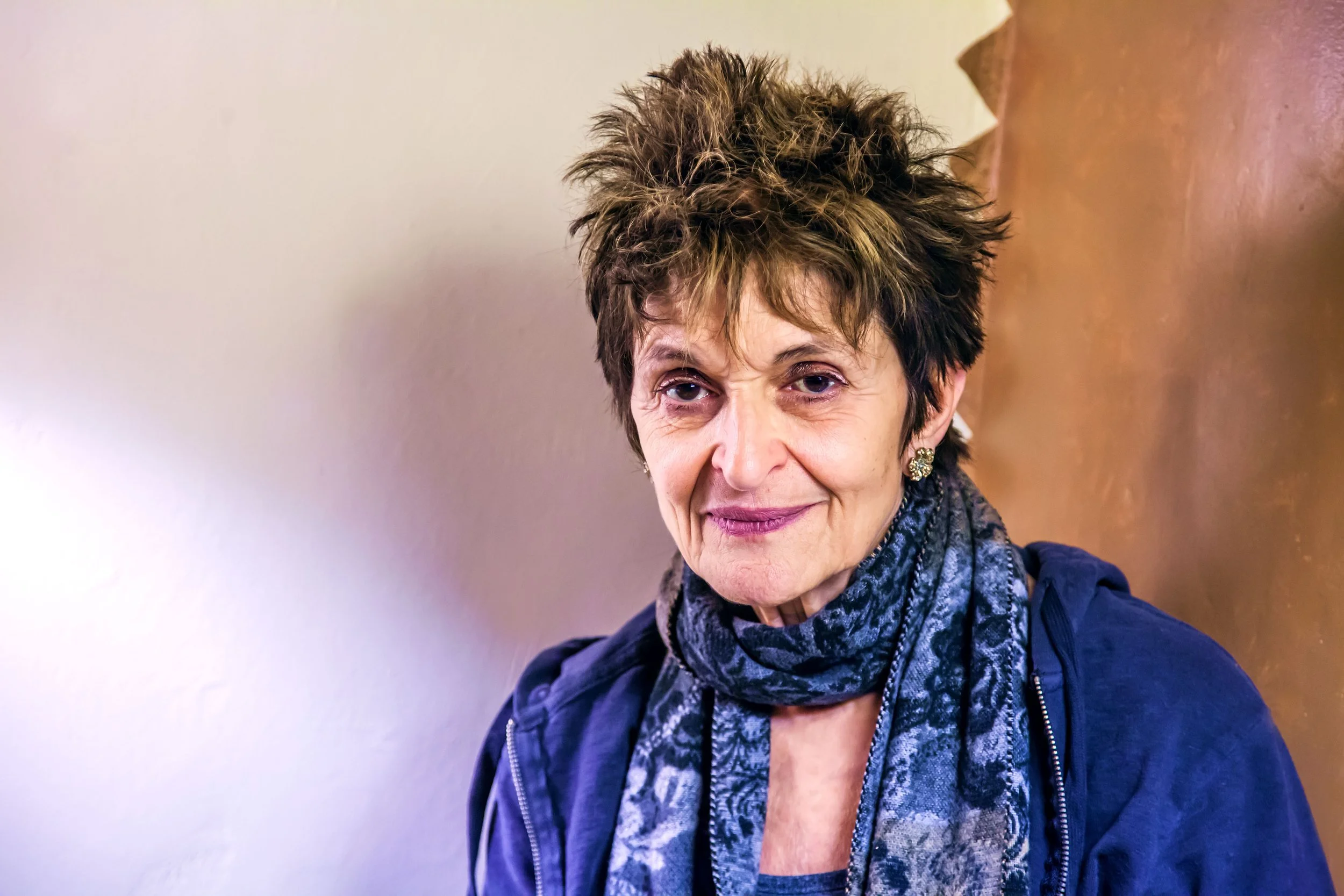
EUGENIA PARRY— The recipient of Masters and Doctorate degrees from Harvard University, Eugenia is a former professor of art history and department chair at Wellesley College. She has lectured widely, and has written over 150 books and essays for exhibition catalogs and periodicals on the history of art, photography, and the creative processes of artists.A master gardener, she lives in Santa Fe, New Mexico, where she is now in charge of the Rose Garden. Tomorrow, she says, she’ll be feeding 400 plants.
It’s Thursday afternoon, and on I-25N a few miles from Santa Fe, a sign offers free iconography tours from 1 – 4 p.m. A right on US Hwy 285S, and in a few minutes you see the white-washed St. Elias the Prophet Greek Orthodox Church, nestled amid pinions and junipers. Another small sign in the church yard cautions, ‘Do not disturb; spring bulbs sleeping.’
It was put there by Eugenia Parry, author, lecturer, former ivy-league professor, volunteer gardener, and tour guide, who’s standing in the nave under the Byzantine murals by Maria Sigala.
“Being here I feel like a great, wonderful cloak has been wrapped around me and holds me,” says Nia. “It’s an intimate, warm, peaceful feeling. You’re held by the tranquil expressions of the saints with their furrowed brows, their look of transition as they move between the real world and the heavenly realm.
“That contradiction between feeling at peace and held by figures who are in my presence but allude to another dimension is complex, and very rich. It’s a feeling of protection, of a larger force that seems to care. You often think of the Book of Job, of people suffering as God watches, but these saints have a protective aura about them: you’re cradled, you’re wrapped, you’re being held by a force, and it’s a great feeling.
“When icons are beautifully painted on the wall, as opposed to painted on canvas and applied, they seem embedded in the church itself. I love these chalky blues, chalky pinks, the delicate intricacy of the designs. There’s nothing hurried about this work. I am blown away by the quality and the timelessness of these figures. They’ve been painted recently, but they have an existence that precedes them — a persistent idea of sacrifice, of courage, of beneficence. Iconography expresses, instructs; it’s meant to be otherworldly — and makes our churches a paradise.
“The Orthodox faith is holistic: for your head, your heart, all your senses. It’s a way of life. This church is my life — even when I’m alone here, I’m not alone — God is here, the saints are here.”
This conversation took place on March 2013, and you and Nia, who was born of Greek parents in the South Side of Chicago, have remained close. When she calls after receiving In Search of the Nativity: A Visual Pilgrimage, she says, “I’ve got your book on my lap, but I tell you, it needs a piece of furniture! I weighed it: 9 lbs! It should be on wheels, just a beautiful little mahogany desk, so you could wheel it around the house in case you want to look at a couple of things before you go to bed at night.”
“I’m a student of art history, but I’ve never studied anything like this. It’s a whole new way of looking at imagery. I’ve gone through the book page by page: it’s an encyclopedia of faith, I felt very healed by it. It’s a breath of fresh air in difficult times, a guide to sanity. It’s not just faith: it’s being able to see another dimension of human existence.
“I’m blown away by the sincerity, the energy of all those wonderful iconographers that I met in this book: they’re people who have been bitten by the spirit and who have devoted their lives and their incredible talents to sacred art, people who are painting these icons, painting stained glass windows, decorating every conceivable surface They’re introducing us to faith through art, and that’s a tremendous thing.
“There is a woman, Tatiana Romanova Grant, who’s in her own spiritual cocoon. She and others are reviving a passion for the spirit. Look at her photo: that’s not a face from our world. Tatiana has been transformed; she’s completely different from most people. She’s been affected by what she was doing. She was living on a mountain, in a log cabin heated with a wood stove. She was thought of as a hermit. Wow. You can see it in her face! She’s in another world.
“There’s so much here: Sister Anna is a perfect way to start the book: ‘Icons are a special form of art that does not look for something new and different, but for the eternal, imaged in the temporal. One has to look slowly at an icon, carefully… one must have the eyes to see through the representation in the picture to the spiritual meaning behind it. Thus, reading an icon is like reading any Scripture: it opens a truth to the soul. So an icon asks a viewer to spend some time with it — and listen to what it says.’ She’s so right, so clear-headed. And she knows you well. It was a beautiful introduction: like having one of your teachers from childhood who already understands who you are. I felt her presence was very important.
“I always thought of icons as thresholds. The saints that are represented ask you to come where they are. I remember when they had that big The Glory of Byzantium exhibition at the Metropolitan: parishes brought their people into the Met and they were trying to kiss the icons — because that’s how people deal with icons— and the guards were keeping them back! I remember a priest telling me: we kiss icons because, ‘you’d kiss a dear friend, wouldn’t you?’
“This book was an opportunity for you to surrender to chance, in a way. You put yourself at the crossroads, and the fates took you everywhere! In Houston, to Dean Thompson who says, ‘As an Anglican, I am steeped in Celtic Christianity, the ancient witness of SS. Enda, Columba, Aidan, and so forth, from the 400s through the 600s. The Celts spoke of ‘thin places,’ those geographic spots that seem to be stripped so thin that the veil between the material and the spiritual becomes porous and we encounter God.’
“Well, he’s right. These people like Dean Thompson are fantastic! You couldn’t have asked for anything more. And that’s the thing about this book: you are introduced to a group of people like the Dean and Maria Sigala and her husband who are committed to taking things you can’t really see and making them visible. When Maria was painting St. Elias Greek Orthodox Church in Santa Fe, she spoke about what it was to be an iconographer and how you’re working out of your own soul. You don’t need to listen to me: these people have said it all: they’re totally committed to joining with the unseeable and making it visible. What else can you say?
“I began to turn the pages and I thought to myself, how can I express what this book does — because it’s a transformative experience. I’m not just turning pages of an encyclopedia. Stuff is being thrown at me: you have been meeting all these incredible people for the past eleven or so years. This book is a record of where you’ve been, all of these places you never expected. Ninilchik, Alaska? What? Sleepy Eye, Minnesota? It’s like a secret, this discovery of icons that give people hope, beauty, alternatives to their daily lives.
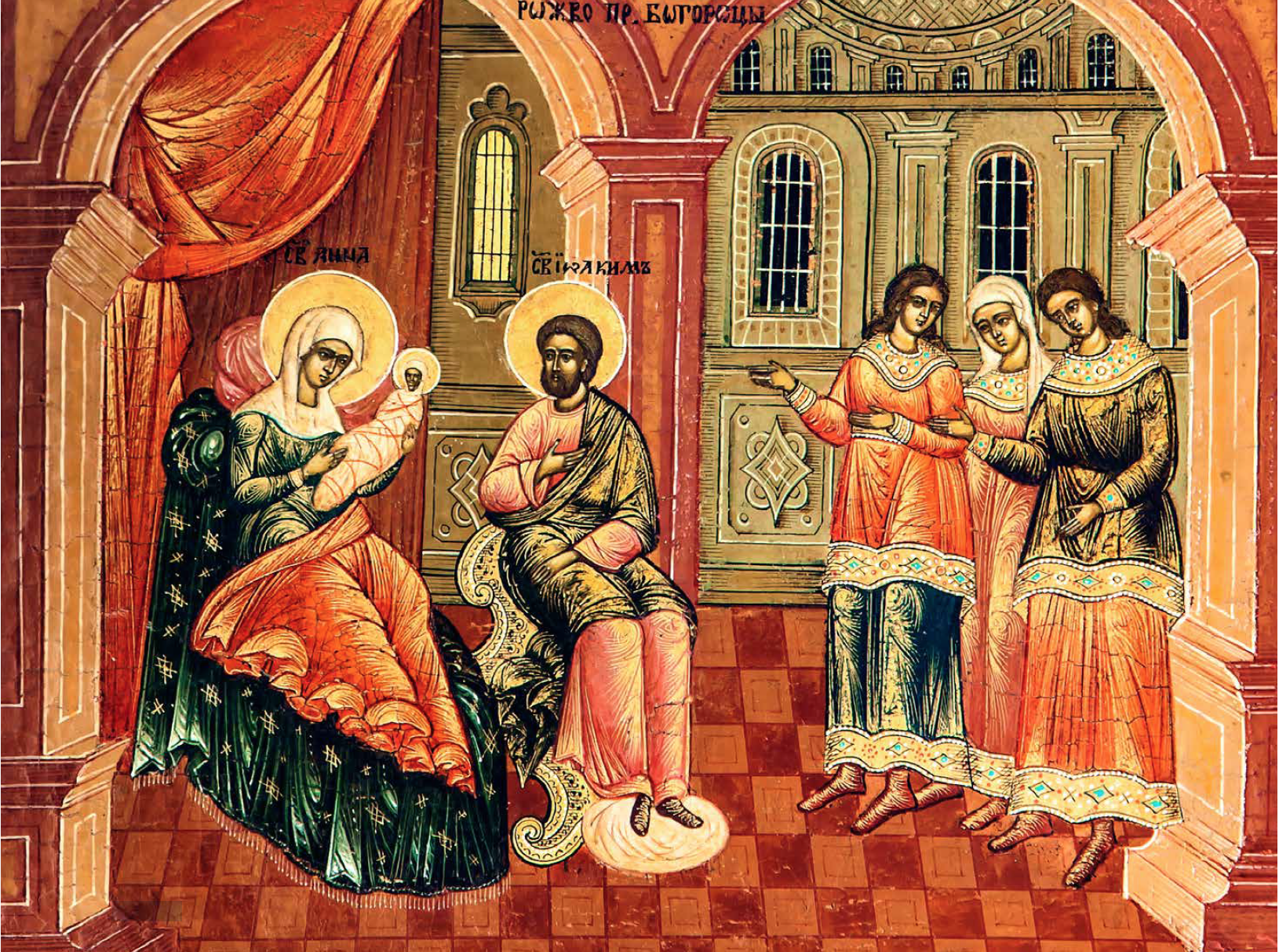
NATIVITY OF THE MOTHER OF GOD — Attended by Joachim, Anna cradles the infant Mary, as three maidens point toward the child. Detail from the Nativity of Christ, the Nativity of the Virgin, circa 1800, the Robin R. Jones Collection, Little Rock, AR.
“Then there are all the stories: how did this exquisite Russian icon get to Little Rock, Arkansas? Robin Jones tells us, ‘Icons really touched me. I put them on the piano, and that night I woke up feeling that there was something holy in the house.’ The story of these images and how they circulate is amazing. And it’s all happening under the table; I don’t think the world knows the extent of iconography, this amazing imagery that is being perpetuated over and over again. Still these great people provide us with something to focus on that’s transcendent. You can’t pull the reins back. It’s going to overflow — you can’t control it, you have to surrender. And I like the idea of surrendering to a work of art, because I’ve been doing it all my life.
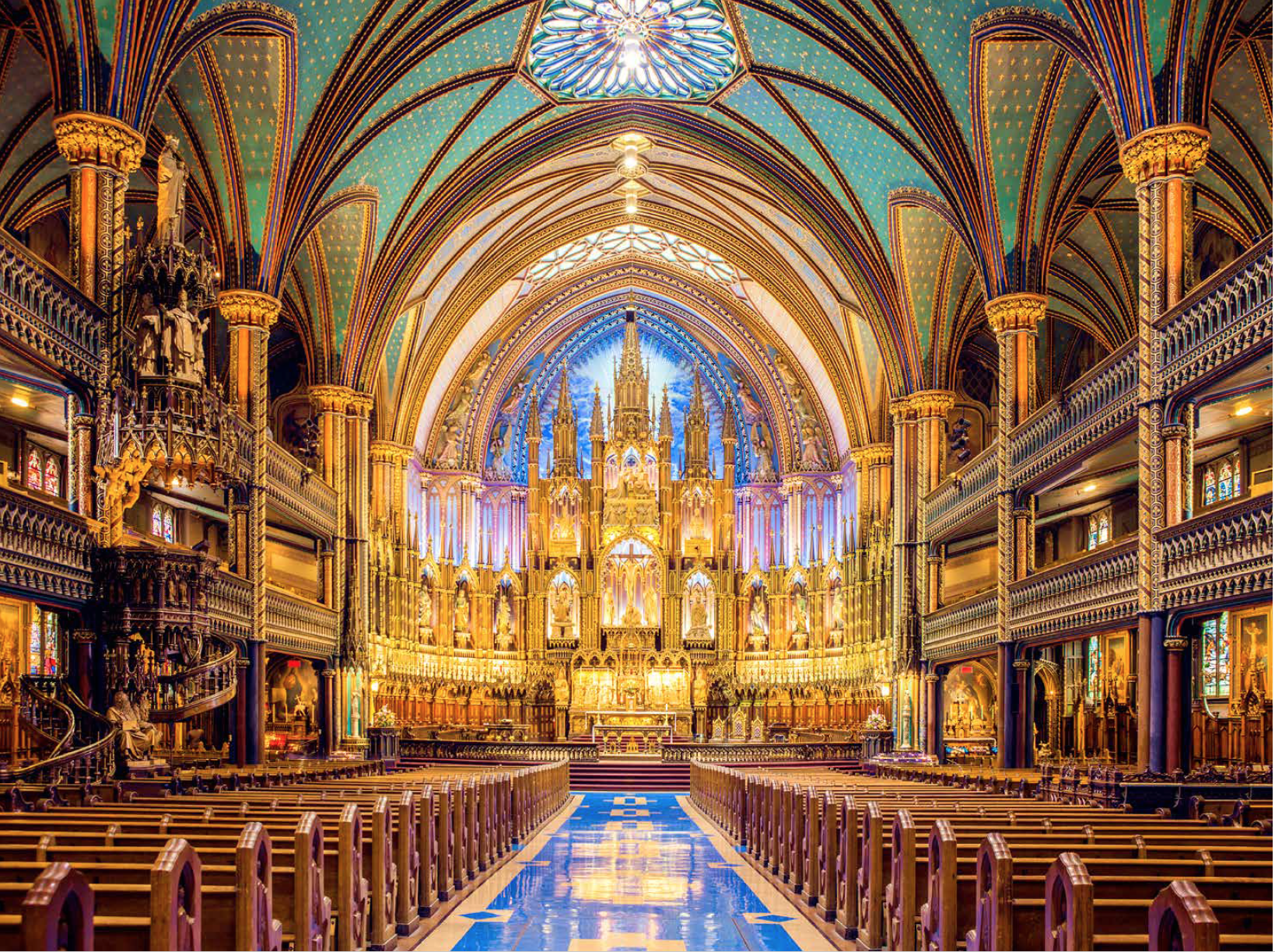
NOTRE-DAME BASILICA OF MONTREAL — The interior grandeur of one of North America’s most beautiful churches includes this exquisite sanctuary that represents the Sacrament of the Eucharist and Christ’s Sacrifice, affirmed by depictions of the Last Supper and the Crucifixion.
“There’s Notre-Dame Basilica de Montreal, a beautiful cathedral — and I think to myself: I don’t know about it; I need to know about such places. In Search of the Nativity: A Visual Pilgrimage is a guide book: you see something and think, I’ll go there. Half this stuff I never knew existed! It gives you reason to see a shrine, a monastery.
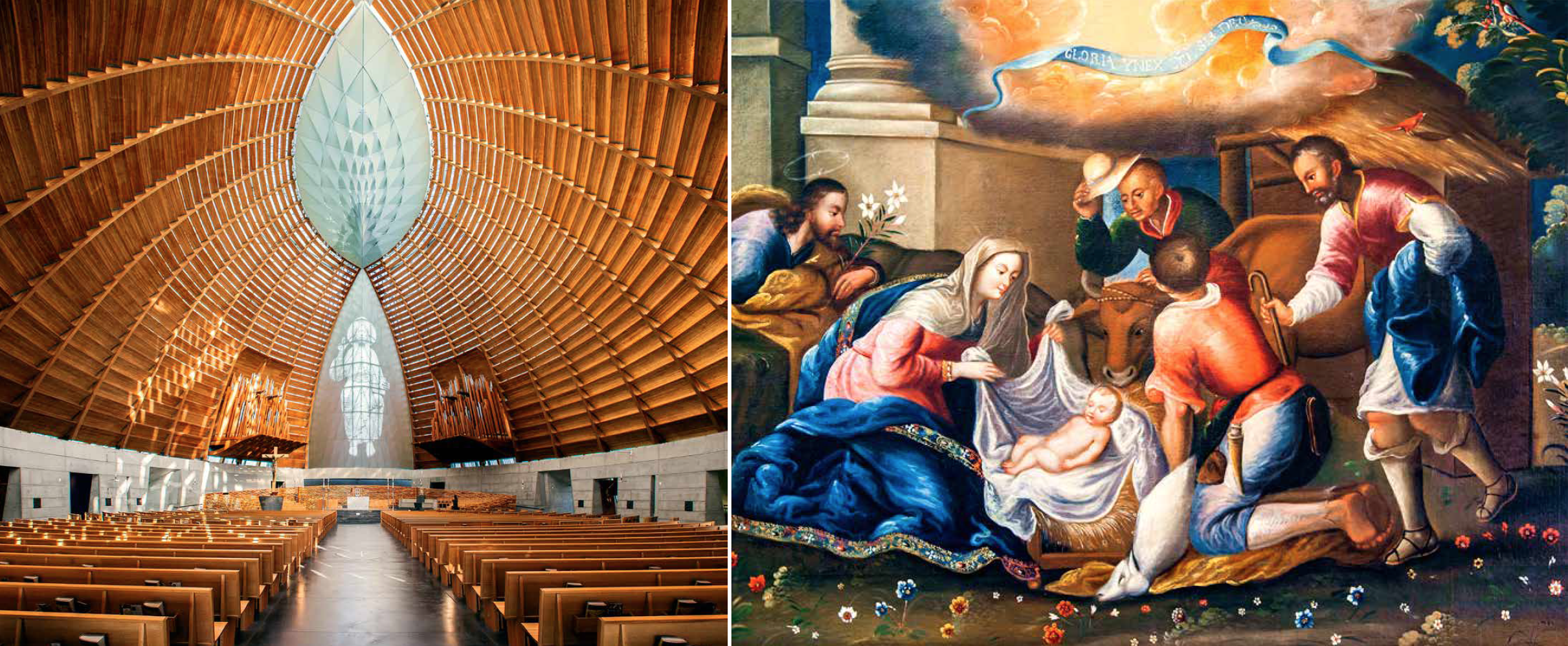
(Left) THE OMEGA WINDOW: A CONNECTION WITH THE BIBLE, AND THE MEDIEVAL PAST OF THE CHURCH — Light shining through 94,000 perforations on aluminum panels paints an almost- 60-foot-high image of Christ in Majesty, the sculpture on the west facade of Chartres Cathedral in France. (Right) ADORATION OF THE SHEPHERDS — The 16th-century Spanish Conquest brought the European artistic tradition to local artists who made it their own with native flora and fauna as decorative elements, embellishing costumes with elaborate designs (see the border of the mantle of the Virgin). Cuzco School, mid-1600s, attributed to the Diego Quispe Tito studio, Chapel of the Holy Family, Cathedral of Christ the Light, Oakland, CA.
“I’m looking at California, page 222: what in heaven’s name is this? It isn’t just an icon: it’s creative architecture — and it’s breathtaking. I didn’t know who created this image of Christ, but this is incredible. The rector of the Cathedral of Christ the Light in Oakland tells us that the sanctuary’s ethereal, 60-foot high image, ‘is Christ in Majesty, painted by light, shining through 94,000 holes. Designer Lonny Israel brilliantly recreated the 12th-century sculpture from the west facade of Chartres Cathedral,’ by drilling holes of various sizes in an aluminum panel.
“Then there’s the Cuzco paintings: that shepherd lifting his hat, the cow’s head right in the midst, the flora and fauna, absolutely lovely. These images have an innocence, a sweetness to them. And who is this wonderful woman, Carminda Gutierez, the docent who took the time to give you a tour? That’s what I liked about this book: it’s like going to church again!
“There’s nothing like this; you invented this. It looks like in search of the Nativity — but it’s in search of a lot more. We see pictures that were made centuries ago, but you’re not just showing holy icons, you have sacred woods! There’s this forest on Spruce Island that seems to quake with spirituality. Tremendous richness. A steady insistence of the holy that penetrates everything: a room, the woods, ferns, buildings. You think that all is not lost: this stuff is powerful and persistent, the insistence of the holy.
And on Spruce Island having a dog show you the way? That is a magical. Everything was a discovery that you never expected. And then you had all these iconographers, clerics, and people to help you push this through. You couldn’t have done it without any of the people you have met! It takes a village, that’s what this book represents. It’s quaking, it’s breathing, it’s moving without perceiving it. It’s not a regular book. As you’ve said, it’s an armchair traveler’s companion. Definitely, because most of us will never see these places. Look at Mt. Athos. I’ll never be able to go there — bring it to me!
“It’s unique, and appropriate right now in our soulless world. People are going to grab this book like a life saver. As I did. I needed to have this book. Not only because you’re my friend, but I want to be a part of that quest: yours was the search for meaning and connections that are very important to me. You had to figure out where your path was; it was a sacred path, an effort to make something beautiful of what you believe. That’s art in a nutshell.
